The Hera spacecraft was launched from Cape Canaveral Space Force Station on 7 October 2024 (JST). On 18 October 2026 (JST), while at a distance of 1,280 km from the target binary asteroid system, Hera captured images of the primary asteroid Didymos and its satellite Dimorphos using the Asteroid Framing Camera (AFC).
(Source: https://www.esa.int/Space_Safety/Hera/First_light_Hera_resolves_two_asteroids_instead_of_one)
The Hera spacecraft conducted its second braking maneuver on 22 October 2026 (JST) and is now approaching the Didymos-Dimorphos binary asteroid system at a relative velocity of 20 m/s. Ahead of arrival, final trajectory-correction trim burns are planned for 25, 28, and 31 October (JST). Hera is expected to reach a position 20-30 km from the binary asteroid system on 4 November 2026 (JST).
The Hera spacecraft is equipped with three imaging instruments: the Asteroid Framing Camera (AFC), the Hyper Spectral Imager on Hera (HS-H), and the Thermal Infrared Imager (TIRI). These instruments will conduct observations of the Didymos-Dimorphos binary asteroid system throughout Hera’s approach and proximity-operation phases. An overview of the mission timeline for Hera’s proximity operations is presented in Figure 1, and the planned observation and operational phases, together with their observation objectives, are summarized in Table 1.

Figure 1. Hera Mission Timeline (Image credit: ESA)
(Source: https://www.esa.int/Enabling_Support/Operations/Hera_operations)
Table 1. Upcoming Observation and Operations Phases and Observation Plan (as of 2 November 2026)
| Date (JST) | Observation Operations Phase | Distance from the Asteroids | Observation Plan |
| 4 November 2026 | Arrival at the Binary Asteroid System and Start of the Early Characterization Phase (ECP) (approximately 4 weeks) | 20-30km | Simultaneous observations of the mass, shape, orbital dynamics, and rotational properties of the asteroid system using AFC, HS-H, and TIRI |
| 2 December 2026 | Start of the Detailed Characterization Phase (DCP) (approximately 6 weeks) | 8-20km | Observations for the characterization of surface morphology, internal structure, and physical properties |
| 13 January 2027 | Start of the Probe Deployment Phase (PDP) | 20–30 km | Deployment of the two CubeSats: Juventas (16 January) and Milani (30 January) |
| 3 February 2027 | Start of the Close Observation Phase (COP) (approximately 12 weeks) | 4-22km | Observations of the artificial crater formed on Dimorphos by the DART impact, detailed surface mapping from low altitudes, multipoint measurements by the main spacecraft and CubeSats, and autonomous proximity operations |
| 28 April 2027 | Start of the Experimental Operations Phase (EXP)(approximately 5 weeks) | Closest approach distance: less than 2 km | Detailed observations of the crater on Dimorphos formed by the DART impact |
| June 2027 | End of Nominal Operations | TBD | Extended Operations Phase (EXT): To Be Determined |
During the approach phase to the Didymos-Dimorphos binary asteroid system, from 2 October to 4 November 2026 (JST), Hera will observe the asteroids as they gradually increase in apparent size, evolving from point-like sources of light into discernible worlds. Similar to the approach of Hayabusa2 to asteroid Ryugu, the steadily improving images will provide new insights on a daily basis, inspiring ongoing scientific discussion and analysis among researchers.
During the approximately four-week Early Characterization Phase (ECP), beginning on 4 November 2026 (JST), the Hera spacecraft will perform its first global survey of both Didymos and Dimorphos, characterizing their masses, shapes, and orbital and rotational dynamics.
To keep both asteroids within the field of view simultaneously while maintaining a large solar phase angle favorable for topographic and shape measurements, Hera will operate at an altitude of 20–30 km above the asteroid system along a 3:4 rectangular trajectory, completing one circuit approximately every two weeks (Figure 2). At each corner of the rectangular trajectory, thruster firings will be performed for orbit control, resulting in approximately two maneuvers per week.
As Hera follows this trajectory, taking three to four days to traverse each side of the rectangle, the spacecraft will point toward Didymos while the AFC, HS-H, and TIRI instruments acquire observations. In addition to regular simultaneous observations by all instruments at intervals of approximately 15–20 minutes, enabling global coverage of both asteroids, TIRI will conduct continuous imaging over one full rotation of the rapidly rotating asteroid Didymos (rotation period: 2.26 hours), as indicated by the red segments in Figure 2.
Approximately twice per day, the spacecraft will reorient itself to point its high-gain antenna toward Earth and downlink the acquired scientific data.

Figure 2. Spacecraft trajectory during the Early Characterization Phase (ECP), viewed from the Sun-facing direction. Didymos is located at the coordinate origin, and the orbit of Dimorphos is shown in red. Continuous observations spanning one full rotation of Didymos are conducted along the red segments, while simultaneous AFC, HS-H, and TIRI observations are acquired at regular intervals along the blue segments.
During the approximately six-week Detailed Characterization Phase (DCP), beginning on 2 December 2026 (JST), Hera will perform an enhanced global survey of the Didymos-Dimorphos binary asteroid system, building upon the observations acquired during the Early Characterization Phase (ECP).
Hera will operate along a bowtie-shaped trajectory (Figure 3), maintaining an altitude of 8–20 km above the asteroid system, allowing TIRI to keep both asteroids within its field of view simultaneously. In addition to providing the large solar phase angles favorable for topographic and shape measurements, this trajectory also includes regions with small solar phase angles, which are advantageous for gravity measurements and investigations of the asteroids’ physical properties and composition.
As in the ECP, Hera will complete one circuit of the bowtie-shaped trajectory every two weeks. Thruster firings for orbit maintenance and control will be performed at each corner of the trajectory. While traversing the trajectory over periods of three and four days, Hera will conduct observations similar to those performed during the ECP. These measurements will provide a more detailed global characterization of the surface morphology, internal structure, and physical properties of both Didymos and Dimorphos.
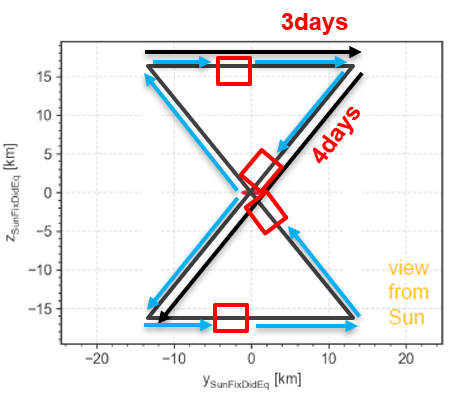
Figure 3. Spacecraft trajectory during the Detailed Characterization Phase (DCP), viewed from the Sun-facing direction. Didymos is located at the coordinate origin, and the orbital path of its moonlet Dimorphos is shown in red. As during the Early Characterization Phase (ECP), continuous observations of Didymos are carried out along the red segments, while AFC, HS-H, and TIRI acquire simultaneous images at regular intervals along the blue segments.
During the Payload Deployment Phase (PDP), scheduled from 13 January to 2 February 2027 (JST), Hera will deploy its two 6U CubeSats, Juventas and Milani, one after the other from an altitude of approximately 30 km above the Didymos-Dimorphos binary asteroid system.
The CubeSats will then spend two to three months conducting close-range investigations of the asteroid system before eventually landing on Dimorphos. Juventas will probe the moonlet’s internal structure using radar measurements, while Milani will characterize its surface composition through visible and near-infrared spectroscopic imaging.
The Thermal Infrared Imager (TIRI) aboard Hera is also expected to continuously image the CubeSat deployment events, documenting this key phase of the mission.
During the approximately five-week Close Observation Phase (COP), beginning on 3 February 2027 (JST), Hera will make a series of close flybys of the Didymos-Dimorphos binary asteroid system, approaching to within 4 km of the surface to obtain the mission’s highest-resolution observations prior to the experimental operations phase.
Compared with the Detailed Characterization Phase (DCP), these observations will provide significantly higher-resolution measurements of the asteroid surface morphology. Particular attention will be paid to the impact site and crater created by NASA’s Double Asteroid Redirection Test (DART) mission, enabling a detailed investigation of the effects of the kinetic impact on Dimorphos.
In addition, Hera will perform more precise gravity measurements and investigations of the internal structure of the asteroid system through three-point measurements involving the main spacecraft and the two deployed CubeSats. The phase will also include tests of autonomous proximity operations, in which the spacecraft navigates using distinctive surface landmarks as reference points.
Thruster firings for trajectory control will be conducted at both ends of each flyby trajectory. Observations by Hera’s instruments will generally follow the same strategy as during the ECP; however, high-cadence imaging during closest approach is also being considered (green boxes in Figure 4).

Figure 4. Spacecraft trajectory during the Close Observation Phase (COP), viewed from the Sun-facing direction. Didymos is located at the coordinate origin, and the orbital path of its moonlet Dimorphos is shown in red. As in the ECP, continuous observations of asteroid Didymos are carried out along the red segments, while AFC, HS-H, and TIRI acquire simultaneous images at regular intervals along the blue segments. The green segments indicate periods of rapid-sequence imaging of the impact crater on Dimorphos created by NASA’s DART mission.
During the Experimental Phase (EXP), from 28 April to 2 June 2027 (JST), Hera will carry out its most ambitious proximity operations, performing flybys that bring the spacecraft to within approximately 1 km of Dimorphos (Figure 5). These observations will provide the highest-resolution views of the asteroid obtained during the mission, enabling detailed investigations of the DART impact crater and the surrounding surface morphology. Continuous imaging by TIRI is also planned during closest approach. The exact operational profile of this phase is still being refined.

Figure 5. Spacecraft trajectory during the Experimental Phase (EXP), viewed from the north-pole direction. The left panel is an enlarged view of the binary asteroid system shown in the right panel. Hera conducts flyby observations at distances as close as 1 km from Dimorphos (approximately 2 km from Didymos), while AFC, HS-H, and other instruments perform simultaneous observations.
Following Hera’s arrival at the Didymos-Dimorphos binary asteroid system, an initial observation campaign and calibration of the scientific data will be conducted. The first scientific results from these early observations are expected to be presented at the Hera Arrival Event organized by ESA in Berlin, Germany, on 25 November 2026 (JST).
We will continue to analyze data from the Hera spacecraft and share the latest findings and mission updates through our social media platform X and on our website as they become available.
Stay tuned for humanity’s first full-scale planetary defense mission!
Hera JAPAN
2 November 2026
Go to Press kit ↓
fhttps://hera.isas.jaxa.jp/wp-hera/wp-content/uploads/2026/11/Hera_Press_Kit_20261102A.pdf